Career
Career
I study computer science and machine learning at California Baptist University and hold an active DoD Secret clearance. Most of my work sits where AI meets defense: knowledge graphs, retrieval, agentic systems, and reasoning you can actually verify. Here is what I have built.

NREIP · NSWC Corona Division · Summer 2026
A fully local AI agent
No cloud, no outside API calls, nothing leaving customer-owned hardware. That sounds like a limitation until you realize it means owning the entire stack: the model, the tools, the memory, and the reasoning. I worked the whole vertical.
Making a Windows host, a declarative Linux VM, and a containerized agent behave like one coherent product was the hardest problem of the summer. The agent also transcribes speech offline with Whisper and voice-activity detection, so you can interrupt it mid-answer. It pulls diagnostics from real hardware over SSH, picks up new tools from a skills marketplace, and reviews its own past sessions to propose improvements.
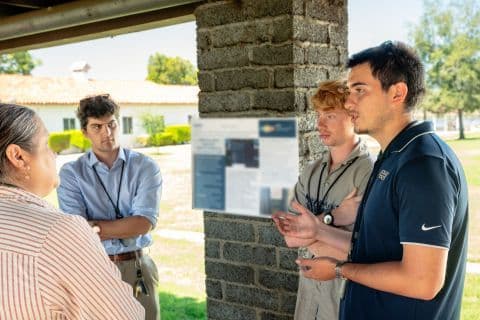
- Operator.NET 9 interface. Watch the agent reason step by step and approve each action before it runs.
- StreamWebSockets stream the agent's reasoning live instead of a loading spinner.
- ApplianceHyper-V virtual machine running NixOS. The whole box rebuilds from one config file.
- RuntimeDocker stack: the ZeroClaw agent, llama.cpp serving the model on multiple GPUs, PostgreSQL for session memory, ChromaDB for sources to cite.
- ZeroClaw
- .NET 9
- Hyper-V
- NixOS
- Docker
- Kubernetes
- llama.cpp
- PostgreSQL
- ChromaDB
- WebSockets
- Whisper
- SSH
Computer vision
I rebuilt a YOLO inference path with TensorRT, and built an auto-labeler that draws the bounding boxes and keypoints for you.
- Inferences / sec at 960px
- 17–20 → 60
- Detection accuracy
- 96% → 99.96%
- Labeling workload
- −48%
Research · Open source
nl2logic: turning military doctrine into provable logic
Military doctrine is written in natural language, but reasoning systems need precise logic. Every formal statement has to trace back to its source text, and abstaining is better than hallucinating.
A fine-tuned T5-family model generates Controlled Natural Language, with every decode step constrained by a finite-state machine built from the CNL grammar. Only grammar-valid output compiles into KIF over the SUMO ontology, and a grounding gate checks each candidate against its source sentence before routing it to accept, review, or reject.
Accepted statements form a prover-ready domain theory. A proof-backed demo translates a classification subset into TPTP, checks consistency with the Vampire theorem prover, and answers questions with named source evidence and explicit assumptions. A comparison harness benchmarks rules-only, raw, and constrained generation on FM 2-0.
It grew out of the SUMO ontology work I did at CAiMLL, below.
- Python
- T5
- Constrained decoding
- CNL
- KIF
- SUMO
- TPTP
- Vampire
Experience
CAiMLL, the CBU AI & Machine Learning Lab
AI Team · Software Engineer Intern
Jun 2025 – Present
Promoted from the knowledge graph team. We design multi-agent orchestrations on Google Cloud that ingest, process, and serve real-time data through Cloud Functions, Pub/Sub, and custom APIs, supporting DINA, NavalX's Defense Innovation Navigation Assistant. I build LangGraph and LangChain workflows for transcript summarization and entity extraction, and manage the embeddings and agentic flows behind them.
- GCP
- Cloud Functions
- Pub/Sub
- LangGraph
- LangChain
- Vector embeddings
Knowledge Graph Team Lead
Nov 2024 – Jun 2025
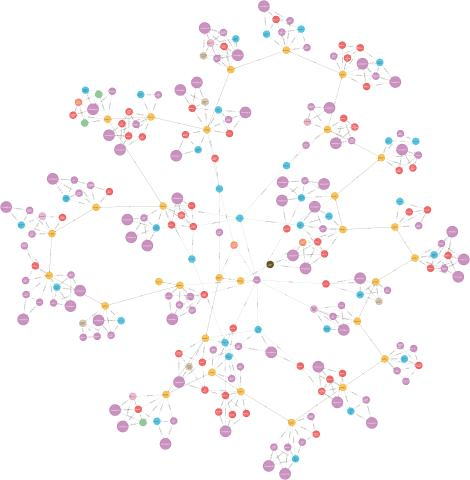
Led a team of five engineers building an early retrieval-augmented generation system that later became known as GraphRAG. We designed knowledge graph schemas for DoD and NavalX datasets and transformed relational data from MySQL into Neo4j. I engineered the framework's three parts: an extractor that pulls entities, attributes, and relationships across multiple LLM providers; a Neo4j graph store using hierarchical Leiden community detection; and a query engine that blends semantic search, fuzzy keyword matching, and BM25 before handing context to an LLM.
- Neo4j
- MySQL
- Leiden
- BM25
- Python
- SUMO
- Scholarship
- SMART Scholar · Phase 1 · NSWC Dahlgren Division
- Clearance
- DoD Secret · Active
Want the details, or want to talk?